The monthly number
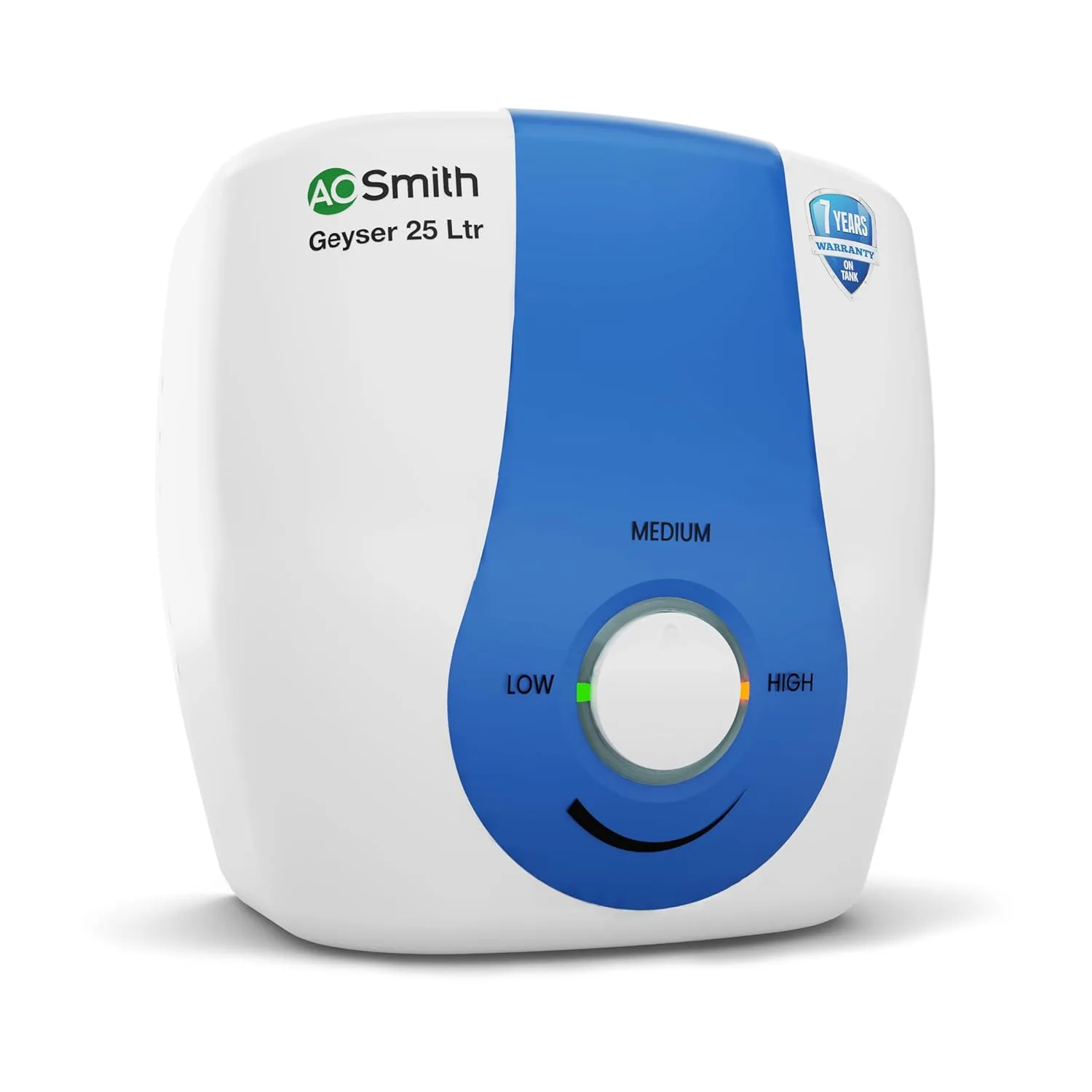
A 2,000 W storage geyser with a 25-litre tank, used by a family of four, consumes roughly 800 kWh a year. At Rs8 per unit that is about Rs6,400 a year, or Rs530 a month.
For most Indian households that makes the geyser the second or third largest single line on the electricity bill, behind the air conditioner and sometimes the refrigerator. It is also the one most easily reduced, because a meaningful share of it is spent on nothing at all.
Standing loss: the figure nobody prints
A storage geyser keeps 25 litres of water hot continuously. Water in a tank cools, the thermostat notices, and the element reheats it. This happens whether or not anyone uses hot water.
That is standing loss, and on a well-insulated 25-litre tank it runs at roughly 0.6 kWh per 24 hours.
| Period | Standing loss | Cost at Rs8/kWh |
|---|---|---|
| Per day | 0.6 kWh | Rs4.80 |
| Per month | 18 kWh | Rs145 |
| Per year | 219 kWh | Rs1,750 |
Rs1,750 a year to keep water hot for nobody. It appears on no product listing, and it is the single most actionable number in this article.
Switching off, properly
The fix is to switch the geyser off when it is not needed, and the detail that matters is where.
Most Indian installations have a dedicated 16 A switch on the wall near the geyser. Turning that off cuts power to the element and stops standing loss. Turning off only a bathroom light switch, or leaving an indicator glowing, does not.
The counter-argument people raise is that reheating from cold costs more than maintaining temperature. The arithmetic does not support it:
- Heating 25 litres from 25°C to 60°C takes roughly 1.0 kWh and about 15 minutes.
- Maintaining that temperature for 24 hours costs 0.6 kWh.
If you use hot water once a day, heating on demand costs about 1.0 kWh. Leaving it on costs 1.0 kWh for the same heating plus 0.6 kWh of standing loss. Switching off is cheaper for any usage pattern with a gap longer than a few hours.
A simple timer switch, or a 16 A smart plug set to turn on twenty minutes before the morning shower, automates this and removes the need to remember.
Instant versus storage
An instant or tankless geyser heats water only while the tap is running, so it has no standing loss at all. That sounds decisive, and it is not, because of what it cannot do.
| Storage 25 L | Instant 3 L | |
|---|---|---|
| Standing loss | 0.6 kWh/day | None |
| Fills a bucket | Yes | Slowly |
| Serves multiple outlets | Yes | No |
| Wait before use | 15 minutes | Seconds |
| Suits | Families, baths | One person, handwashing |
For a single person taking short showers, an instant geyser is genuinely cheaper to run. For a family drawing hot water for baths and buckets, a storage geyser switched off between uses beats both a storage geyser left on and an instant unit struggling to keep up.
What the star rating actually measures
A BEE star rating on a storage water heater is worth reading correctly, because it does not mean what it means on an air conditioner.
Converting electricity to heat in a resistive element is close to 100 percent efficient, in every geyser ever made. There is no efficiency to improve. What the star rating chiefly reflects is insulation quality, and therefore standing loss.
So a 5-star geyser saves money specifically on the hours it sits idle. If you already switch yours off between uses, you have removed most of the thing the rating measures, and the premium buys less than the label suggests.
Cost by household size
The Rs530 figure is a family of four. Consumption scales with hot water drawn, so the number moves substantially with household size — and the standing loss component does not move at all, which is what makes it disproportionately expensive for small households.
| Household | Monthly kWh | Cost at Rs8 | Of which standing loss |
|---|---|---|---|
| 1 person | About 30 | Rs240 | Rs145 (60%) |
| 2 people | About 42 | Rs336 | Rs145 (43%) |
| 4 people | About 66 | Rs530 | Rs145 (27%) |
| 6 people | About 90 | Rs720 | Rs145 (20%) |
For a single person leaving the geyser on, roughly sixty percent of the bill is standing loss. They are paying more to keep water hot than to use it. That is the household for whom switching off — or choosing an instant geyser instead — makes the largest proportional difference.
Temperature setting: the trade nobody explains
Most storage geysers let you set the thermostat, commonly between 40°C and 75°C, and the setting affects both cost and safety in opposite directions.
Lower is cheaper. A smaller gap between tank temperature and room temperature means slower heat loss, so standing loss falls. Dropping from 70°C to 60°C reduces it by roughly fifteen to twenty percent.
Too low is a health question. Legionella bacteria multiply in stagnant water between about 20°C and 45°C, and are killed reliably above 60°C. This is why 60°C is the widely recommended setting rather than the lowest one available.
The practical answer for most households is 60°C: hot enough to control bacterial growth, cool enough to limit standing loss, and hot enough that you mix in cold water at the tap — which is itself a sign the setting is not wastefully high.
A setting above 65°C is worth reconsidering. It increases standing loss, accelerates scale formation on the element in hard water, and raises scalding risk, particularly with children in the house.
Hard water and scale
Across much of India the water is hard, and this changes the running-cost picture in a way no calculator accounts for.
Dissolved calcium and magnesium precipitate onto the heating element as it heats. That scale layer is an insulator, so the element must run longer and hotter to deliver the same water temperature. Consumption rises quietly, over years, with no visible symptom other than a bill that will not come down.
A heavily scaled element can consume noticeably more energy than a clean one for identical output, and scale also causes the element to overheat locally, which is a common failure mode.
Two things help. Descaling the tank and element every two to three years in hard-water areas is straightforward for a plumber and restores most of the loss. And if you already have a water softener for the house, running the geyser feed through it extends both element and tank life considerably.
Where solar fits
A solar water heater changes the arithmetic more than any efficiency upgrade, and it is worth being realistic about both sides.
A 100-litre domestic solar system costs roughly Rs20,000 to Rs30,000 installed and can supply most hot water needs for eight to ten months of the year in most of India. Against a Rs6,400 annual geyser bill, simple payback lands around four to five years, with a service life of fifteen to twenty.
The qualifications matter. It needs unshaded roof space with a southern aspect. It underperforms during monsoon and through cold north Indian winter mornings, which is precisely when hot water is most wanted — so an electric backup is not optional. And it is not viable for most apartment residents without building-level agreement.
Where those conditions are met it is the single largest reduction available on this line of the bill. Where they are not, switching the existing geyser off between uses remains the best available action, at no cost at all.
Sizing: bigger is not safer
Geyser capacity is often chosen by rounding up, and the cost of that decision is permanent.
Standing loss scales with tank surface area. A 25-litre tank loses more than a 15-litre one, every day, for the life of the appliance — whether or not you ever use the extra fifteen litres.
Reasonable sizing for Indian households:
- 6 to 10 litres — handwashing and kitchen use, or a single person taking short showers.
- 15 litres — one to two people, showers.
- 25 litres — a family of three to four, or anyone filling a bucket for a bath.
- 35 litres and above — larger families, or multiple bathrooms on one unit.
Choosing one size larger than you need buys a small amount of headroom and pays for it in standing loss every day for a decade.
The failure nobody plans for
A glass-lined storage geyser should last twelve to fifteen years. A great many fail at around seven, and the reason is a component most owners have never heard of.
Inside the tank is a magnesium anode rod. It is deliberately more reactive than the tank lining, so corrosion attacks the rod instead of the steel. It is sacrificial by design and it is consumed.
Once the anode has dissolved, corrosion moves to the tank. From that point the geyser is on a countdown. The rod should be inspected roughly every two years and replaced when spent, which costs a few hundred rupees and is almost never done.
In hard-water areas the rod is consumed faster, and scale on the element compounds the problem by forcing longer heating cycles for the same water temperature.
The short version
- Switch it off at the 16 A wall switch between uses. Roughly Rs1,750 a year, for no loss of comfort.
- Heat on demand. Fifteen minutes before you need it is enough for 25 litres.
- Use a timer or a 16 A smart plug so it happens without being remembered.
- Check the anode rod every two years. A few hundred rupees against replacing the geyser years early.
The star rating matters least of the four, because it addresses the standing loss you can eliminate for free.