What the star rating actually promises
The star on the label is not a measurement. It is a band, and the band is defined by a number called ISEER — the Indian Seasonal Energy Efficiency Ratio. ISEER is the total cooling a unit delivers over a notional cooling season divided by the total electricity it consumes to deliver it. A higher figure means more cooling per unit of electricity.
Two things follow from that, and both matter before you spend money.
First, ISEER is a ratio, not a running cost. It tells you how efficiently the machine converts electricity into cooling, not how much electricity you will buy. That depends on how long you run it.
Second, the star bands are periodically rebased by the Bureau of Energy Efficiency. The ISEER value that earned five stars several years ago earns fewer today, because the whole scale moves as the market improves. A “5 star” claim is only meaningful alongside the year it was awarded. This is why every air conditioner in our catalogue records the rating year next to the star count.
The two units we are comparing
Both are 1.5-tonne inverter split units, the most common size sold into Indian homes. Both figures below are the manufacturers’ BEE-declared values, measured at BEE’s standard assumption of 1,600 hours of use per year.
| Unit | ISEER | Declared consumption | Price |
|---|---|---|---|
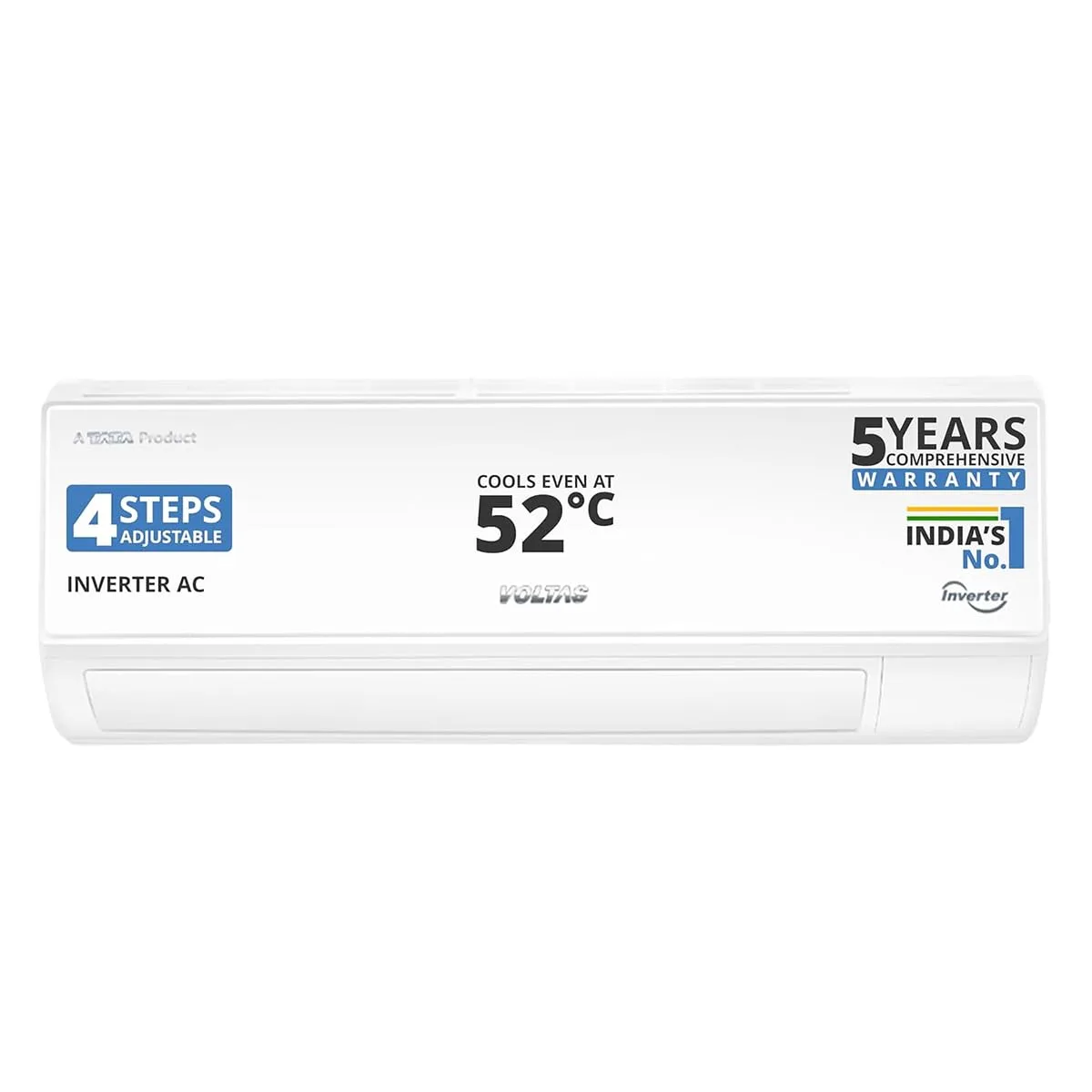
| Voltas 1.5 Ton 3 Star Inverter Split AC (183V Vectra) | 3.80 | 1,082 kWh/yr | ₹34,990 |
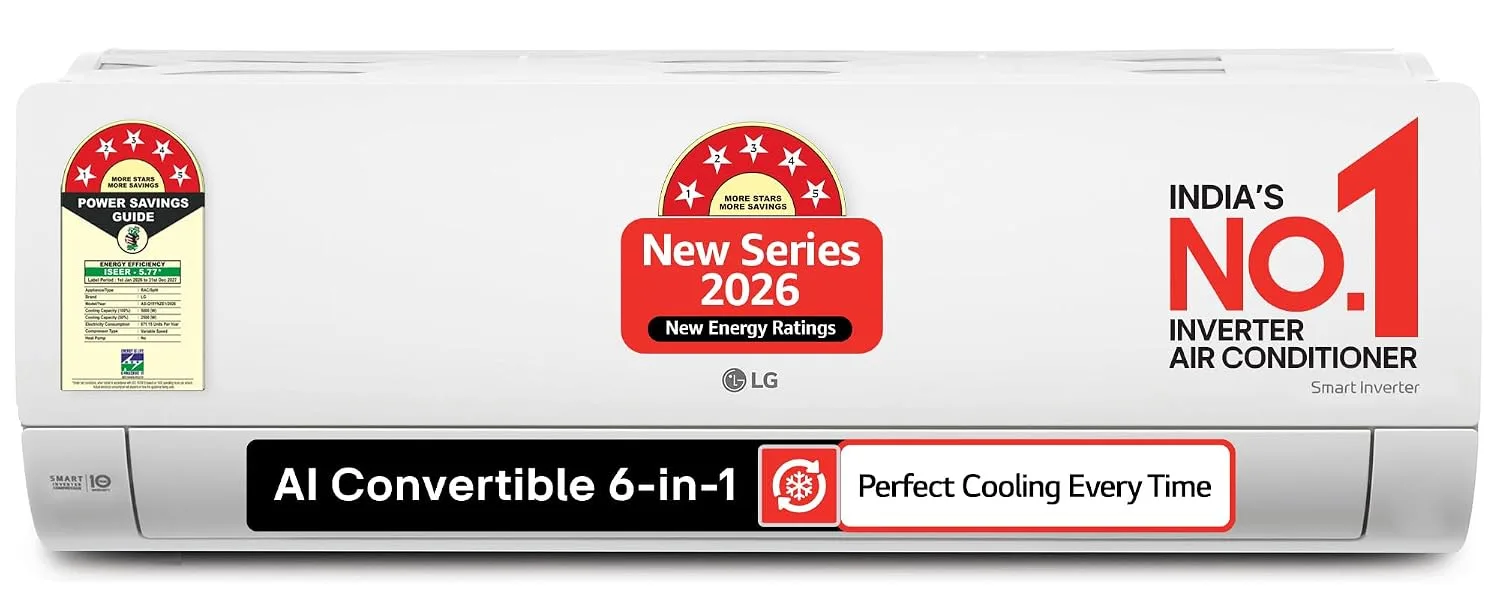
| LG 1.5 Ton 5 Star AI DUAL Inverter Split AC (PS-Q19YNZE) | 5.10 | 806 kWh/yr | ₹52,490 |
The efficiency gap is real and substantial: 34% more cooling per unit of electricity. The price gap is also real: ₹17,500, exactly 50% more than the 3-star unit.
These are different manufacturers, so this is not a perfectly controlled comparison — build quality, warranty terms and installation costs differ. But the energy figures are measured against the same standard, which is the entire point of a mandatory rating scheme, and the price gap is representative of what the market charges for the jump.
The saving, in rupees
The difference in declared consumption is 276 kWh per year. Converting that to money requires a tariff, and Indian residential tariffs are slab-based and vary sharply by state. A household already running an air conditioner is usually in an upper slab, so ₹7 to ₹8 per unit is a fair working range, with some metros higher.
| Tariff | Annual saving | Saved over 3 years | Payback on ₹17,500 |
|---|---|---|---|
| ₹6/kWh | ₹1,656 | ₹4,968 | 10.6 years |
| ₹7/kWh | ₹1,932 | ₹5,796 | 9.1 years |
| ₹8/kWh | ₹2,208 | ₹6,624 | 7.9 years |
| ₹10/kWh | ₹2,760 | ₹8,280 | 6.3 years |
At no realistic tariff does the premium return inside three years. At the midpoint of the range, three years of savings recover ₹6,624 of a ₹17,500 premium — about 38% of it.
Hours matter more than tariff
BEE’s 1,600-hour assumption is a national average, and averages are unhelpful for a product whose use depends entirely on climate. A household in Bengaluru might run an air conditioner 1,200 hours a year. One in Chennai, Delhi or Nagpur can comfortably exceed 2,400.
Because the saving scales with hours and the premium does not, usage changes the answer far more than tariff does. At ₹8/kWh:
| Hours per year | 3-star | 5-star | Annual saving | Payback |
|---|---|---|---|---|
| 1,200 | 812 kWh | 604 kWh | ₹1,656 | 10.6 years |
| 1,600 (BEE) | 1,082 kWh | 806 kWh | ₹2,208 | 7.9 years |
| 2,000 | 1,352 kWh | 1,008 kWh | ₹2,760 | 6.3 years |
| 2,400 | 1,623 kWh | 1,209 kWh | ₹3,312 | 5.3 years |
The spread is the finding. A light user waits more than a decade — longer than the unit is likely to last in service. A heavy user in a hot city gets there in a little over five years, comfortably inside the life of the machine.
What this means if you are buying
Buy the 5-star if
- You are in a hot-climate city and will run the unit 2,000 hours a year or more.
- You expect to keep the unit ten years or longer, and it will not move house with you.
- Your tariff slab is above ₹8/kWh, which is common in metros once air-conditioning pushes consumption up.
The 3-star is the better buy if
- You use air conditioning seasonally — a few hot months rather than most of the year.
- The ₹17,500 difference would be better spent on a second unit for another room, which changes comfort far more than efficiency does.
- You are fitting out a rental and may not keep the appliance.
Three things the payback maths leaves out
Installation and copper. Longer pipe runs cost more and reduce efficiency. A poorly installed 5-star unit can consume more than a well-installed 3-star one, and no label captures that.
Maintenance. A dirty filter or fouled condenser coil costs more efficiency than the entire gap between these two units. Cleaning is the cheapest efficiency upgrade available.
Rebasing. If you are comparing a new unit against an older one still on the shelf, check the rating year. Under a previous schedule the same ISEER figure may have carried an extra star.
How ISEER is measured, and where it diverges from your home
ISEER is not measured by running an air conditioner in a house. It is measured in a laboratory across a defined temperature bin distribution — a weighted set of outdoor conditions meant to represent an Indian cooling season. The unit is tested at several load points, the cooling delivered is totalled, the electricity consumed is totalled, and the ratio is published.
That method is the right one for comparison, because it holds conditions identical across every manufacturer. It is a weaker predictor of your actual bill, for reasons worth knowing.
The test assumes a correctly sized unit in a sealed, insulated space. Most Indian installations are neither. It assumes clean filters and coils throughout. It assumes a stable supply voltage, where many homes see sag during peak evening demand — and a compressor working against low voltage draws more current for the same cooling.
It also assumes the thermostat is set to a temperature the unit can reach and hold. Set an air conditioner to 18°C in a room it can only bring to 24°C and the compressor never modulates down. An inverter unit run that way behaves like a non-inverter unit and gives up most of the efficiency you paid for. The single largest lever on your bill is not the star rating. It is the set temperature, and each degree higher is worth roughly three to five per cent of consumption.
Sizing matters more than stars
Before comparing efficiency at all, get the capacity right, because an oversized unit wastes more than a low rating does.
An air conditioner removes heat and moisture. An oversized unit cools the air to the set point quickly, satisfies the thermostat, and shuts off before it has run long enough to pull humidity out. The room reaches the right temperature and still feels clammy, so occupants lower the set point — which is why oversizing so often produces both discomfort and a high bill.
Short cycling also hurts the machine. Compressor starts are the hardest moment in its operating life, and a unit that starts and stops repeatedly wears faster than one that runs long, steady cycles at partial load. Inverter compressors tolerate this far better than fixed-speed ones, but they are not immune.
As a working rule for Indian conditions, 1 tonne suits roughly 100 to 120 square feet, 1.5 tonne suits 150 to 180, and 2 tonne suits 200 to 250. Adjust upward for a top-floor room, a west-facing wall, large unshaded glazing, or a kitchen. Adjust downward for a shaded ground-floor room in a moderate climate. If a room falls between two sizes, the smaller unit running longer cycles will usually feel better and cost less than the larger one short cycling.
Comparing across rating years: a worked example
Rebasing is the trap most likely to cost you money, so it is worth seeing concretely.
Suppose a showroom has clearance stock rated under an older schedule alongside current models. The older unit carries a 5-star label with an ISEER of 4.5. The current unit carries a 4-star label with an ISEER of 4.7. On stars alone the older unit wins. On the measurement that actually determines your bill, the newer unit is 4.4% more efficient.
The star count is a position within a band, and the bands move. The ISEER figure is an absolute measurement and does not. When the two disagree, the ISEER figure is the one to trust — which is why the label carries both, and why our catalogue records the rating year alongside every star count rather than treating stars as self-explanatory.
The same caution applies to any efficiency claim carried over from an earlier product generation in marketing material. A manufacturer is not obliged to restate an older rating against the current schedule, and generally will not.
The short version
Five-star air conditioners are sold on a payback story that does not hold over three years and often does not hold over five. That does not make them a bad purchase — it makes the reason to buy one different from the reason you are given. Buy the efficient unit because you run it hard and will keep it a long time, not because the salesperson said it pays for itself.